Thursday, January 04, 2007
Use of Remote Access - 2006
Faculty, residents, and students have been using our remote access capabilities from off campus to access our electronic resources. 2006 use was up by 34 % from 2005. Users logged 2,262,083 hits to our electronic books, journals, and databases. Statistics also show that remote access is used 24/7 making us a truly virtual library.

Tuesday, December 19, 2006
New Resource
The library now has a subscription to Ulrich's Periodicals Directory. Ulrich's gives detailed information on over 290,000 periodicals from across the world.
Ulrich's Periodicals Directory is listed on the Databases page.
Ulrich's Periodicals Directory is listed on the Databases page.
Monday, December 18, 2006
Now available! -- EndNote Web
EndNote Web is a new tool that helps you to easily explore research literature, write papers and collaborate via the Web. With EndNote Web, you can:
- Search ISI Web of Science, PubMed and other databases directly
- Import references from Ovid Medline, PsycINFO, PubMed, Current Contents Connect, and other databases
- Store up to 10,000 records per user account
- Edit references — add notes and keywords, modify any field
- Use over 2,300 publishing styles to format in-text citations and bibliographies
- Cite While You Write™ in Microsoft Word (requires plug-in)
- Format papers in other word processors using RTF (rich text format) files
- Share EndNote Web folders with colleagues
- Use EndNote Web toolbars in Microsoft Internet Explorer and Mozilla® to access your reference library in one click, and capture citation data easily (requires plug-in)
For a comparison between EndNote (Desktop) and EndNote Web see http://www.endnoteweb.com/encompare.asp
EndNote Web is free to AECOM faculty, students, and staff. You must first register by clicking on Web of Science on the library's home page and creating a user name and password.
Once registered, you can login into your account at www.myendnoteweb.com or via Web of Science.
For more information contact the Reference Desk at 718-430-3104 or email askref@aecom.yu.edu
- Search ISI Web of Science, PubMed and other databases directly
- Import references from Ovid Medline, PsycINFO, PubMed, Current Contents Connect, and other databases
- Store up to 10,000 records per user account
- Edit references — add notes and keywords, modify any field
- Use over 2,300 publishing styles to format in-text citations and bibliographies
- Cite While You Write™ in Microsoft Word (requires plug-in)
- Format papers in other word processors using RTF (rich text format) files
- Share EndNote Web folders with colleagues
- Use EndNote Web toolbars in Microsoft Internet Explorer and Mozilla® to access your reference library in one click, and capture citation data easily (requires plug-in)
For a comparison between EndNote (Desktop) and EndNote Web see http://www.endnoteweb.com/encompare.asp
EndNote Web is free to AECOM faculty, students, and staff. You must first register by clicking on Web of Science on the library's home page and creating a user name and password.
Once registered, you can login into your account at www.myendnoteweb.com or via Web of Science.
For more information contact the Reference Desk at 718-430-3104 or email askref@aecom.yu.edu
Monday, December 11, 2006
Free Trials and Demos
Looking for the free trials and demos page? Free trials and demos are now listed directly on the Databases page, instead of listed separately. They are listed alphabetically, with the trial expiration date noted next to the resource. Most are restricted to on-campus use only. Check them out and let us know what you think!
Tuesday, December 05, 2006
Renovated Beren Center
Although the renovated Beren Center has been in use for almost 2 months there were finishing touches to be completed. Today, wonderful photographs were put up. Please stop by to see them. If you can't make it to the library, a sample will be on the Renovation News site on our home page.
http://library.aecom.yu.edu
http://library.aecom.yu.edu
Monday, November 27, 2006
How much was a gallon of gas in 1915, a quart of milk in 1967?
Sometime in 2006 the United States will reach a population of 300 million people. To spotlight this event the Census Bureau has compiled statistics comparing contemporary life with 2 other years of significant population milestones. 2006 is compared to 1967 when the U.S. reached 200 million people and 1915 when it reached 100 million people.
For example:
Tuberculosis
Death rate from this disease per 100,000 population.
2006: 0.2
1967: 3.5
1915: 140.1
(Sources: Upcoming Statistical Abstract of the United States 2007; data pertain to 2003 and 1967. <http://www.census.gov/prod/www/statistical-abstract-1995_2000.html>, 1999 edition, Table 1420. Data pertain to 1915.)
Living Longer
Life expectancy at birth.
2006: 77.8 years
1967: 70.5 years
1915: 54.5 years
<http://www.census.gov/prod/www/statistical-abstract.html>, Table 96. Data pertain to 2005.
(Source: Historical Statistics of the United States: Colonial Times to 1970; data pertain to 1967 and 1915.)
For the 1915 price of gas and the 1967 price of a quart of milk go to the U.S. Census Bureau web site.
For example:
Tuberculosis
Death rate from this disease per 100,000 population.
2006: 0.2
1967: 3.5
1915: 140.1
(Sources: Upcoming Statistical Abstract of the United States 2007; data pertain to 2003 and 1967. <http://www.census.gov/prod/www/statistical-abstract-1995_2000.html>, 1999 edition, Table 1420. Data pertain to 1915.)
Living Longer
Life expectancy at birth.
2006: 77.8 years
1967: 70.5 years
1915: 54.5 years
<http://www.census.gov/prod/www/statistical-abstract.html>, Table 96. Data pertain to 2005.
(Source: Historical Statistics of the United States: Colonial Times to 1970; data pertain to 1967 and 1915.)
For the 1915 price of gas and the 1967 price of a quart of milk go to the U.S. Census Bureau web site.
Mouse Atlas Project (MAP)
The Mouse Atlas Project (MAP) is a project of the Laboratory of Neuroimaging, UCLA.
" ... [It] aims to develop a dynamic, probabilistic atlas of the adult and developing C57BL/6J mouse.
The framework, in the form of a digital atlas of the C57BL/6J mouse brain, is composed of volumes of data acquired from uMRI, blockface imaging, histology, and immunohistochemistry and a set of visualization, database, mapping and measurement tools. Users can import their own data into the atlas and use the same tools to visualize, compare and measure domains of gene expression in normal, gene-targeted knock-out, or transgenic mice. "
The web site includes software, databases and atlas of brain structure, gene expression and imaging.
" ... [It] aims to develop a dynamic, probabilistic atlas of the adult and developing C57BL/6J mouse.
The framework, in the form of a digital atlas of the C57BL/6J mouse brain, is composed of volumes of data acquired from uMRI, blockface imaging, histology, and immunohistochemistry and a set of visualization, database, mapping and measurement tools. Users can import their own data into the atlas and use the same tools to visualize, compare and measure domains of gene expression in normal, gene-targeted knock-out, or transgenic mice. "
The web site includes software, databases and atlas of brain structure, gene expression and imaging.
Monday, November 20, 2006
News Made Easier
Want to keep up to date with the latest library news without checking back each day? Consider setting up an RSS feed.
In Firefox, simply go to the "bookmarks" link at the top of your browser, and select "subscribe to this page."

Or select the orange RSS feed indicator in the address window on the top right hand-side of the the page.
In Internet Explorer 7, select the orange RSS feed indicator in the top-right corner of the web page, and then select your desired feed format (Atom, RSS, etc).

That's all there is to it.
In Firefox, simply go to the "bookmarks" link at the top of your browser, and select "subscribe to this page."
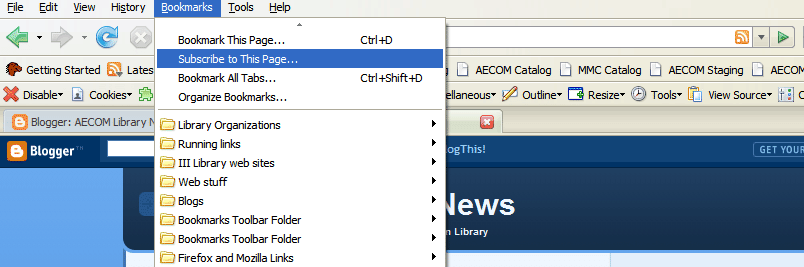
Or select the orange RSS feed indicator
 in the address window on the top right hand-side of the the page.
 In Internet Explorer 7, select the orange RSS feed indicator
 in the top-right corner of the web page, and then select your desired feed format (Atom, RSS, etc).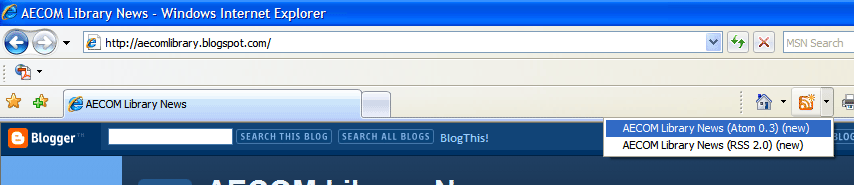
That's all there is to it.
Thursday, November 16, 2006
National Influenza Vaccination Week November 27th. - December 3rd., 2006
Every year in the United States, on average 5% to 20% of the population becomes infected with influenza virus. More than 200,000 people are hospitalized from influenza complications and about 36,000 people die from influenza. Vaccination is the best way to prevent influenza and its severe complications. Anyone who wants to reduce their risk for getting influenza should be vaccinated during each influenza season.
To help raise awareness about the importance of influenza vaccination in November and beyond, the United States Department of Health and Human Services (HHS), including the Centers for Disease Control and Prevention (CDC), the National Influenza Vaccine Summit and other partners announce a National Influenza Vaccination Week (NIVW) to take place from Monday, November 27 through Sunday, December 3, 2006. CDC encourages state and local health departments, public health partners, and providers to plan influenza vaccination clinics and activities to promote influenza vaccination.
Free materials are available for easy printing at the"flu gallery" (www.cdc.gov/flu/gallery), including posters and educational flyers.
To help raise awareness about the importance of influenza vaccination in November and beyond, the United States Department of Health and Human Services (HHS), including the Centers for Disease Control and Prevention (CDC), the National Influenza Vaccine Summit and other partners announce a National Influenza Vaccination Week (NIVW) to take place from Monday, November 27 through Sunday, December 3, 2006. CDC encourages state and local health departments, public health partners, and providers to plan influenza vaccination clinics and activities to promote influenza vaccination.
Free materials are available for easy printing at the"flu gallery" (www.cdc.gov/flu/gallery), including posters and educational flyers.
Saturday, November 11, 2006
Finding the Needle in the BBA Haystack
Do you have a Biochimica et Biophysica Acta (BBA) reference with only the volume number and year? Have you search fruitlessly for the section?
There is now an easy way to find the section. ScienceDirect recently posted a chart called BBA Decoder that lists volume numbers with links to sections. It is a project of the University of California at San Diego Libraries. The section link takes you directly to the top page for that section. Once at the section the volume numbers are listed on the left-hand side. Find your volume, and, voila, you are there.
There is now an easy way to find the section. ScienceDirect recently posted a chart called BBA Decoder that lists volume numbers with links to sections. It is a project of the University of California at San Diego Libraries. The section link takes you directly to the top page for that section. Once at the section the volume numbers are listed on the left-hand side. Find your volume, and, voila, you are there.
Subscribe to:
Posts (Atom)